A day in the life of a vanslator, Jiří Toman: Winter Edition

Hi, I’m Jiri, Czech language specialist for all things sport, bicycles, and computer games. I slow-travel around Europe in my camper van while working full-time as a freelancer, trying to spend ¾ of the year on the road. I already wrote about one of my summer days on the road, you can find the post here. In this winter edition, you’ll get a glimpse into one of my winter days at my base camp in České Budějovice, Czechia.

4:15 – Waking up to my alarm clock (I actually woke up for the first time around 2:52, already thinking it was time to get up) because I was invited to speak to translation students at Palacký University in Olomouc (UPOL) about what it takes to be a freelance translator and vanlifer. Since Olomouc is quite far from my hometown, I chose my favorite bike–train–walk combo to get there and back, even if that meant getting up very early. 8 hours in a train where you can work are much better than 6 hours spent only driving a car (not to mention the amount of unnecessary CO₂ emissions). Don’t you agree?

4:20 – Getting dressed, brushing my teeth, grabbing my backpack I prepared yesterday evening to speed the morning up, and leaving my base camp. That’s what I call my uncle’s flat in my hometown where I stay when I’m not on the road in my van. My uncle prefers living in the countryside in a house I half-own with his brother, who lives in another house in a different village. I know it sounds complicated, but we’re all happy with this arrangement.

4:25 – Crossing the street to a bike-sharing station with my favourite pink Rekola bikes, taking one called Vugala (yes, every single one of them has a name) and riding it to the train station through a misty early morning, criss-crossing the main streets just because I can, since the city is serenely empty with no cars around.
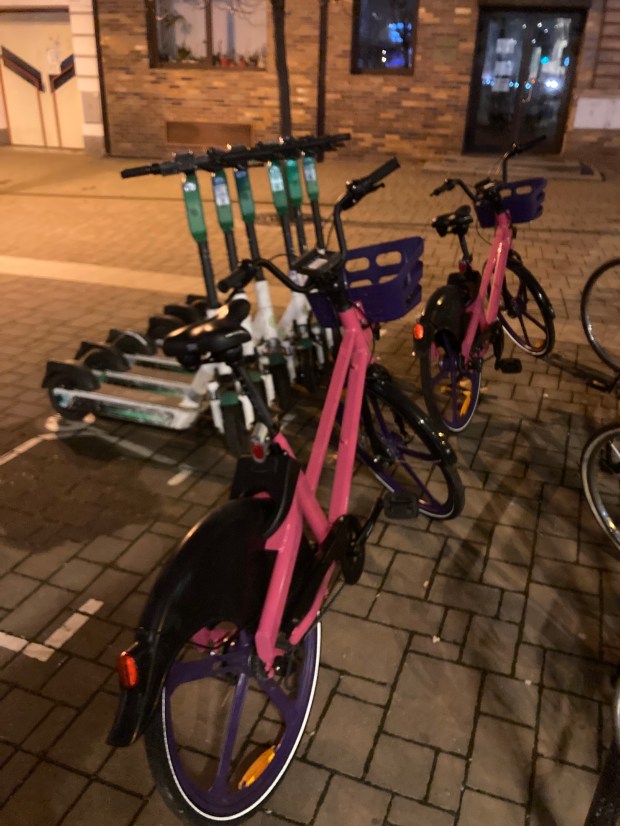
The pink Rekola bike parked up and ready to ride

4:40 – Parking the bike at the train station, buying a hot beverage to complement my breakfast in my backpack, heading to the platform.

4:50 – Eating breakfast in an empty compartment (two pecan nut turnovers and an apple).

5:10 – Starting work. Checking LinkedIn, replying to emails, writing the first parts of this blog post.

6:50 – Changing trains in Prague, eating my second breakfast (the last pecan nut turnover), writing a LinkedIn post about my journey to UPOL and how my freelance business did this year (5% increase in revenue, yippee), you can check it here.

8:35 – Translating a tiny project of 55 words containing packaging copy for bike accessories and an online workshop description for bike retailers. Calling with Pavel, my UPOL contact from the English translation department. He checks whether my train is on time. We arranged a meeting in front of the university at 10:30.
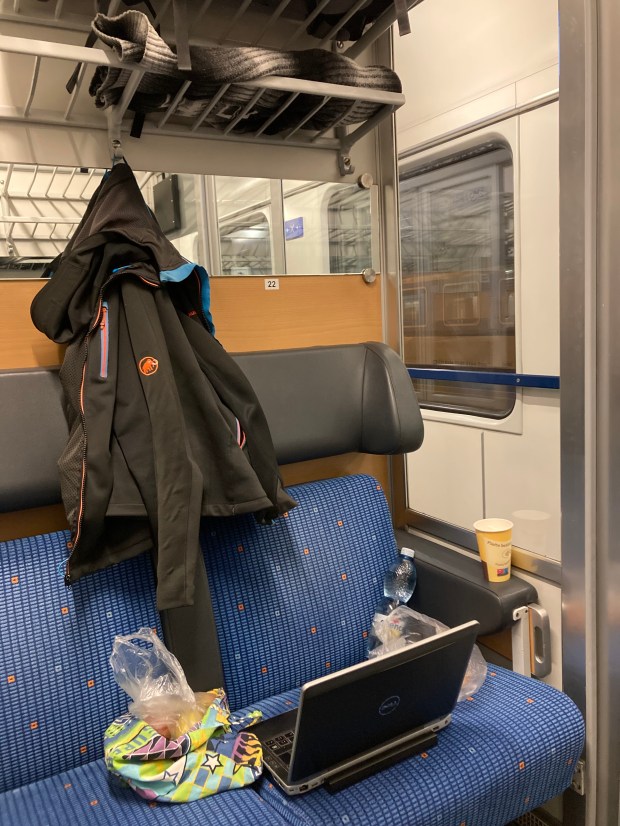
A photo of Jiri's work laptop on a train seat

9:15 – Replying to comments under my LinkedIn post.

9:20 – Getting off the train, heading straight to a pharmacy to buy something for my swollen finger from yesterday’s fall (seems like I’m good at avoiding injuries in the mountains or when climbing, but I still haven’t learned how to walk properly to a bus stop). I hope it’s nothing serious. I can still write, but some finger movements hurt a bit. Walking through Olomouc with my watch on to get an idea of how long it takes to walk from the train station to the university. I lose my way a bit because I can’t remember what the university building looks like, eventually finding the right entrance after a detour through a nice park and fortifications.

10:25 – While waiting for Pavel, I start replying to comments under my LinkedIn post (there are many), checking email, or just watching students going in and out. Nostalgia.

10:30 – Meeting, handshaking, contract signing, talking about my presentation. I get invited to lunch in the university canteen… more nostalgia, thinking about my own university years. We chat about translation and, surprisingly, music, since Pavel is also a guitar player.

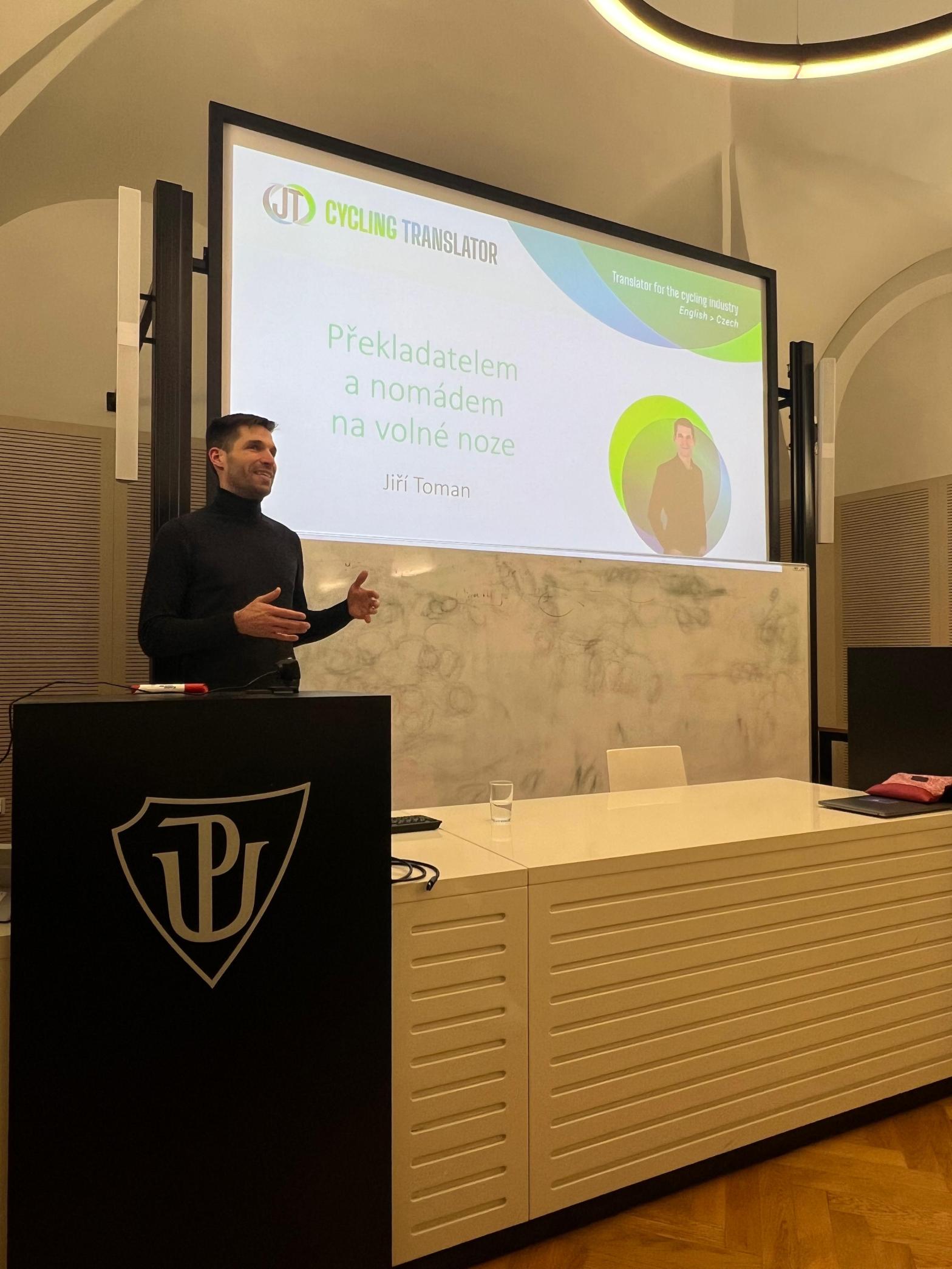
11:30 – Delivering the lecture. Pavel jumps in a few times with relevant remarks. The students don’t look too bored at the end (some even stay longer to ask more questions), which is, according to Pavel, a huge success. I’m happy. 😊

14:05 – Doing a follow-up with Pavel, receiving a small gift (a UPOL-branded thermos), and then chatting in a café about all things translation, vanlife and teaching translation in the age of AI while drinking mint tea and eating cakes.

14:30 – Walking through Olomouc back to the train station, arriving just in time since I know exactly (thanks to my watch) how long it takes. Preparing my headphones and phone for our weekly meeting with the core team of Cyclinguists, a collective of freelance language experts dedicated to cycling I co-founded.

15:00 – Joining the meeting at the train station; I even manage to buy a snack while I’m at it. I continue speaking on the platform and on the train. Unfortunately, the connection isn’t great on a moving train. We update each other on the jobs and accounts we manage for Cyclinguists (we’re currently working on our Code of Ethics and we also provide technical training for freelance linguists who want to specialize in bikes, hit me up if interested).

16:00 – The internet connection is so bad there’s no point in following the last minutes of the meeting, so I start replying to comments under my LinkedIn post again.

16:30 – Continuing with this blog post, checking emails. It seems I was successfully onboarded by an agency for an AI translation editing workflow after doing their (paid) trainings and some (paid) onboarding projects. The workflow for this client mainly covers help articles for mobile games. The juicy part here is that I used to work for this client at the start of my translation career, but through a different agency that stopped sending me work because I became too expensive for them. The conditions are a bit better at this new agency, so in my opinion it’s a win for me and a win for them as well.

16:55 – Translating an email about a sale period for bike service packages. Checking new LinkedIn connection requests and commenting under a few posts. Working on this blog post.

17:40 – Getting off the train, trying to find restrooms at Prague’s train station, checking LinkedIn while waiting for the train that will take me home.

18:20 – Boarding the train, eating some snacks, updating Cyclinguists’ Terms and Conditions based on feedback from our new client, preparing them for signature to kick off our cooperation ASAP. We’ll be post-editing product descriptions for cycling-related accessories and translating email campaigns into German, with me acting as the main client contact and project manager when necessary.

19:20 – Writing this blog post.

20:00 – Getting off the train and heading to the bike-sharing station, taking a pink shared bike again (this time it’s called Bosse) and riding it home through the misty city once more. Back home, quickly swapping my backpack for my guitar, hopping into my car and driving to the Christmas party of my ex-band to spend some time with my musical friends and their fans, playing and singing together.

20:20 – Arriving a bit tired after the long day, but after a short break, some schnitzels and tartare, complemented by Kofola (my favourite Czech fizzy drink, similar to Coca-Cola), I feel ready to party. Even though my finger is a bit swollen, I still manage to play the guitar decently.

1:50 – Arriving home with a few Christmas presents and a box full of Christmas sweets from the party. Surprisingly, I’m still full of energy (this usually happens to me after a good jam session) and not really sleepy yet, so I just tidy up a bit at my base camp, brush my teeth, and take a shower.

2:30 – In bed. Good night. It was a long day, but totally worth it.
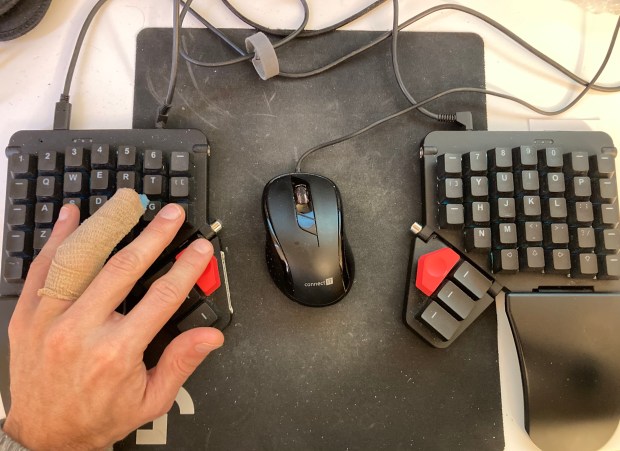
A hand with a strapped up finger using a keyboard

P. S. I went to the doctor with my finger three days later. Turns out it’s actually fractured. Not ideal for writing… let alone playing the guitar. Well, life happens, at least four weeks without my dear guitar and taking it easy at my keyboard (maybe I’ll go back to experimenting with dictation software). Also, more time to think about how to learn walking properly…

A day in the life of Alison Hindley

Hi there, I’m Alison, a German and Italian-to-English translator, specialising in law, the arts and the environment. I also proofread and edit English documents written by non-native writers.

I grew up in leafy Surrey where a short train journey could whisk me into London. My initial ambition, fuelled by school choirs, ballet lessons and trips to the theatre, was to turn life into a musical.

Aged 11, having just started learning French, I was assigned an Austrian penfriend, meeting her in Vienna just a year later after my first few German lessons. There followed school exchanges to Freiburg im Breisgau in the Black Forest. So, my interest in this creative language simply grew as did my continuing friendships.

With my passion for music, I opted to study German with Italian in Southampton. Then, I would know the languages for classical western music at least. After graduation, I spent a year teaching English in northern Germany, returning to teach English as a foreign language in the UK. I ultimately decided to focus on my favourite linguistic task and completed an MA in Translation at Surrey University. After some relevant work experience, my full-time freelance translation career took off in September 1997 in Southampton. Since 2005, I’ve been based in bustling Bristol where I’ve made great connections in my specialisms.

My days are very flexible. Sometimes, I work until 8 pm or later, depending on the deadline. On other days, I may be off to a hobby in the evening and need to stop working at a normal EOB time. Errands fit around ‘spare’ mornings or I meet up with a colleague for a coffee, which is always lovely.

Around 8 am: I get up. I discover we’ve run out of tomatoes. So, given our very mild November, I pop into the garden and pick a few. Then, I make a packed salad lunch for my husband and my own lunch too. Next, I have a relaxing breakfast, watching the news before a quick bath.

By 9.45 am: I am at my desk. I first check any urgent emails and find a proofreading request. So, I need to check my schedule and give a quote with a potential deadline. Then, I head on over to LinkedIn and Facebook. I have a social media role for two professional networks. So, I need to respond to comments about a post-event blog and share any other relevant posts with those networks. I also check WhatsApp and my committee emails.

A committee colleague has shared her draft of a report we’re jointly writing. So, I need to proofread that and return it to her. Once that’s complete, I need to proofread a large translation I finished drafting yesterday. As it is about a composer not that familiar to me, I listen to some of his music during my first read-through.

By midday: It is most definitely time for a coffee and some cake. So, I go to the kitchen downstairs and bring my refreshments back up to the office. It’s time to check messages again briefly. Then, I return to checking my translation for accuracy, comparing the source and target versions.

By 1.45 pm: I have my pre-prepared lunch and watch a comedy show. Then, I do some washing.

By 2.30 pm: I am working again. A colleague has sent me the minutes of our recent AGM to check. Once I have sent that file back, I check for any other messages. The deadline has been confirmed for the potential proofreading project and I add that to my scheduled deadlines. Then, I complete the accuracy check of my translation, providing explanations to the German music titles. What appears simply to mean ‘Writing’ (‘Schreiben’) is also a play on the words ‘Schrei’ (‘shout’) and ‘reiben’ (‘to rub’), reminding me again of the playful nature of German and this composer in particular, who likes instruments to be played in unconventional ways.

By 4.30 pm:  I realise I have forgotten about the washing. So, I hang that up and make a cup of tea and have a banana. Then, I read through my translation again. I am quite happy with it, but it will have a final read-through and spellcheck tomorrow morning. With distance, you can create something that sounds authentic.

At 6 pm: I pack a rucksack and walk to my jazz tap dance class.

At 6.30 pm: We dance to a mix of jazz classics and, sometimes, punk – anything with a good rhythm that suits the routine we’re learning!

At 7.30 pm: There is some time to chat with friends there before I walk home, doing some food shopping on the way.

At 8 pm: I am home again and do some singing practise. After all, those carols won’t sing themselves in my choir’s concerts next month.

From 8.30 pm: My husband and I cook supper, our main meal of the day. This evening, it’s a quick veggie curry.

From 9 pm: We enjoy supper, watching the end of a pivotal televised football match: Scotland will play in the World Cup for the first time in 28 years! We’re not Scottish, but it was very exciting to see (with apologies to any Denmark fans reading this). As it’s midweek, we have a peppermint tea rather than anything stronger.

By 11 pm: The kitchen is tidy again and it’s time for me to be a test audience for my husband’s forthcoming presentation on Demand Responsive Transport (DRT, for short, aka those colourful mini-buses that you can pre-book).

By 12 pm: It’s finally time for bed.

As we’re heading towards the end of the month, I will be tackling my invoices and monthly accounts before December. There will be other projects and committee work too, including an online meeting. Most of all, I am looking forward to a Christmas meal with my regional network next month.

You can stay in touch with me on LinkedIn:

https://www.linkedin.com/in/alisonhindley/

and read my (very occasional) blogs on my website:

A day in the life of Roger Barlow

Hello there. I’m Roger Barlow, a translator originally from Stafford, UK. I’m also a partner at LATAM Translations, based in the sleepy town of Bragança Paulista, Brazil.

I left the UK in 1998, fresh out of a degree in Maths and Stats, intending to spend a year in Brazil. Like so many expats here, that one year somehow became 27, with no immediate plans to leave.

Spending so long in Brazil has given me the language, insight and (eventual) patience to write Brazil Isn’t for Beginners: A Memoir and Survival Guide. The book is a wry, boots-on-the-ground account of expat life here — equal parts cultural commentary, cautionary tale and love letter. Out soon.

My daily routine shifts with the seasons: my busy period runs from February to mid-August during which I’m chained to my desk from 7 a.m. to 10 p.m. — hardly blog-worthy. So, here’s a peek at a typical day in my lighter season, from September to January, when I essentially work part-time and have something resembling a life.

7:15 a.m.

Time to get up. I check out the morning’s news for ten minutes, then have my regular breakfast of overnight oats and blueberries, washed down with a cup of tea.  

8 a.m. to 9 a.m.

Three mornings a week, I hit the gym before work, with religious discipline. I rarely miss it. Even when facing the tightest deadlines, I try to squeeze my workout in. If I didn’t treat this hour as non-negotiable, I’d never see the inside of a gym during the busy season.

9 a.m. to 12:30

I walk from the gym to my office, and jump straight in the shower, as I’m usually soaked in sweat. Then it’s emails and a check-in with our project manager Gabriel, while I brew a litre of green tea. (Yes, a litre.)

If work is slow, I’ll check my socials and work on my upcoming book. My mornings often involve tweaking chapters as new memories surface, brainstorming promotion ideas and banging my head against the desk as I try to learn how to use TikTok and Canva.

Lunch

Most days I eat at home — usually the classic Brazilian combo of rice and beans, plus salad and veg. Then it’s time for a 45-minute siesta. When I first arrived, I assumed it was part of the culture, so I decided to adopt it and haven’t looked back since.

2 p.m. to 6 p.m.

Back to the office for an espresso and some actual remunerated work. These days I mostly translate sustainability reports and financial statements/earnings releases. An apple around 4 p.m. keeps me going until dinner.

Evenings

Twice a week, I head over to the gated-community where my future home is being built. A walk in the woods ensues, followed by a relaxing session in the steam sauna. Nobody ever uses it, and it’s become my unofficial sanctuary over the years. Depending on my mood, I’ll opt for a eucalyptus, peppermint or cedar oil infusion, before taking a dip in the outdoor pool. It’s particularly invigorating in winter, when the temperature drops below 10°C.

Back home, it’s dinner with my wife Fernanda and stepdaughter Júlia. Júlia and I usually watch an episode of Seinfeld, and then maybe something with Fernanda.  I wrap up the day with a couple of chapters of a nonfiction book before bed.

Links

Why location matters in localisation

Photo by The New York Public Library on Unsplash – thank you!

The tale of the town mouse and the country mouse says it all. We can be friends, and we can look similar, but town and country mice often want different things, and live different lives.

In my slow-paced life, you’ve got to be creative. Entertainment and necessity often interlink. Today’s task is collecting petals to make confetti for an upcoming wedding. I’ll do it while out walking with a friend. If I lived in a town or a city, it probably wouldn’t take five minutes to grab some confetti from a shop.

On weekends, we’ll put on our wellies and tramp across several muddy fields to get eggs and bread, paying with coins in the honesty box. It’s a calm, yet sometimes inconvenient bubble. Life in the countryside takes more planning. Last week, I went on a 40-minute round trip to get some Calpol.

I lived in cities when I was a student, and I loved it. I still go to the city for excitement and energy. Learning from museums, viewing art, soaking up the vibrancy and hustle and bustle. Enjoying not having to wait around for one of two daily buses.

When I’m in town, or in a city, I can access convenient services that would normally take militant planning. I can buy almost anything I need, and I can try new things. It’s liberating when going out for lunch means you’re not just bound to the two shelves of sandwiches in the local shop. The same old everyday can get boring, but when you’re faced with a plethora of choices, it’s also overwhelming.

When you’re launching a brand in the UK and you need a cultural consultation, subculture matters.

Where does your target audience live?

  • In a lifestyle where impulsivity is more difficult, will consumers go out of their way to buy from your brand?
  • In a world full of overwhelming choices, what will prompt them to choose your offering over everyone else’s?

This is the kind of thing I ask during cultural consultations. If you’re looking to successfully launch a brand in the UK, I’ll go much deeper than language.

On a people level, we need to take into account that:

  • We might share language, but we don’t all speak the same. Slang is great, especially if it fits your brand voice. But there are plenty of regional words and phrases flying about. This could be an important part of your regional strategy, or something to consider if you’re pitching UK-wide.
  • We have the same amount of time in a day, but we spend our time differently. You might have a product or service that works seamlessly in city spaces, but is it the same in places with a rural infrastructure? Transport links and social and green infrastructure should be part of your considerations when you’re declaring something as simple to access or pick up.
  • We both have to decide what to buy, but our buying decision factors are different. Talking of transport links, how can we make your product or service appeal to people who would have to make an additional trip out to access it? How can we make it more easily accessible so people in rural areas can get it when out and about doing other things (and therefore reduce their carbon footprint)? How can we streamline the process and make it easier for people who are in a hurry or under pressure from the watchful eyes of the growing queue of people behind them?
  • We don’t have the same level of choice. In environments where there’s so much choice, we need to think about how can you differentiate. What makes your product or service appealing to people who often choose to go without? How can it stand out on a shelf of similar products? How can we make your service so easy that people don’t need to create their own workaround to overcome it?
  • We can’t overlook the disposable income divide. Urban areas generally have higher average household incomes. This doesn’t directly translate to a higher standard of living, but it does indicate different regular expenses. Rent in the city might be higher, but so is the cost of transport in rural areas. This needs to be a consideration when you’re defining pricing and subscription models.

With my cultural consultation service, we’ll dive deeper into your target market, and their unique wants, needs, and lifestyle considerations.

Building a customer-centric product or service around your UK customers’ unique challenges means your potential customers will feel understood, valued, catered for, and at home – the heart of all localisation services.

Get in touch to find out more about how I can help you launch your brand in the UK today.

Go back

Your message has been sent

Warning
Warning
Warning
Warning.

A day in the life of Dr. Andrew Hudson

In 1975, when I was seven years old, I walked to an old lady’s house, knocked on her front door, and said “I’m supposed to take piano lessons from you, but I really want to draw comic books.” Thus began my musical career. The comic book thing wasn’t a fluke—I was serious about it, even traveling to New York with my family once to tour DC comics. I still read Batman. But around the age of 15, I knew I had to make a choice, and, for better or for worse, I chose the piano. I attended the North Carolina school of the arts, the Cincinnati Conservatory of music, and the university of Texas at Austin, and in 1998 earned a Doctorate in Piano Performance. This doctorate qualified me to be a low paid, part-time instructor for 20 years, at which point I said, “screw this” and, at the age of 45, looked for something else I could do with my life.

I found it in something my father had taught me. When I was about 12, he taught me to say “Guten Morgen. Guten Abend, Gute Nacht,” and something took—I thought it was beautiful. Still do. And this led to a lifetime of interest in the German language. So, when my musical career was floundering mid-life, I gave translating a try. It was a smash hit. I loved it, made more money than I was making teaching with a doctorate and 25 years of experience. And I’ve been doing it ever since.

Here’s what my day looks like:

6am My wife and I get up at his ungodly hour because she teaches public school. She gets ready, and I make her breakfast. And the you have it, the two things I’m craziest about: my wife and food (if I had a third career, I might go to culinary school and become a chef).

7am After she takes off—with me in her rear-view mirror waving goodbye, as I’ve done every morning for ten years—I go back up to our fourth-floor condo and get to work. Unless I go back to bed. But usually, I get to work.

The first thing I do is watch German news on Tagesschau while drinking good coffee (I refuse to drink any other kind). Then I spend the rest of the hour on LinkedIn. Although I’ve never gotten a job on LinkedIn from a new client, I’ve met lots of cool people there, and some of them have forwarded some really lucrative gigs my way.

8am From 8 to 9, I handle our finances: accounting for our budget, sending invoices, tracking late payments, etc.

9am Here’s where I start “deep work.” If I have translating to do, it begins here. If I don’t, I might do anything from practice the piano to go for a walk. I also do household chores at this time: dishes for sure, maybe vacuuming, maybe “decluttering.”

11:30 Lunch. Either at home or at a coffee shop downtown. Since I work exclusively online, it’s great to go out and talk to my friends there. Unlike some translators, I’m an extrovert. I talk to whoever shows up, sometimes for hours. After I finish lunch, I work at the coffee shop on my laptop. And after that, I might stop by a local cocktail bar on my way home.

After lunch, I take a nap if I’m home. Usually about 20 to 30 minutes.

1–4pm I try to finish up any work that’s due the next day (usually in Germany, meaning before I go to bed in the US). I also do any prep work for dinner: starting artisan bread, cutting vegetables, attending to my mise en place.

4pm I start dinner.

5:30 My wife gets home.

5:30 We eat dinner and watch TV. Movies, Your Honor, Gordan Ramsey shows, Star Trek: Deep Space Nine, Nurse Jackie.

9pm Go to bed, read on our phones until we fall asleep.

A day in the life of Katie Uniacke

Hi there, I’m Katie, a Spanish and Portuguese-to-English marketing translator, copywriter, subtitler, aspiring travel writer and (very occasionally) voiceover artist.

I was born in a quiet, picturesque corner of the UK countryside, fell in love with Spanish at school, and my Spanish and Portuguese degree gave me the chance to spend a year in Brazil and another in Mexico.

I then decided that Granada, Spain, was the place for me and my burgeoning freelance career. Once I was there, I quickly collected two Spanish companions to share my life and home with: my husband and Monty the podenco. We all moved to Zaragoza in 2021.

As with everyone else who’s shared their days here, mine are very flexible beasts, liable to turn out all kinds of ways. But here’s how an average one unfolds in the autumn, when I’m at home rather than flitting around and working from anywhere.

This time of year is all about hibernation, preserving my energy levels and focusing on what I want the year to come to bring. Spring is about networking and getting out of the house, but autumn is for taking it easy, whilst also finally ticking off those on-the-business jobs I’ve had on my list all year.

Around 8 am: I generally let myself wake up naturally, which happens soon after it gets light outside (pretty late in Spain for most of the year). I’m not a human being until I’ve had breakfast, so it’s straight to the kitchen for a hearty one.

Brain and body fuelled for the time being, I either head for the sofa or my desk, fire up my laptop and spend a little too much time faffing on LinkedIn, commenting and scrolling, probably composing a post if I haven’t had a rush of blood to the head the previous day and got one ready.

The rest of this time is dedicated to emails, and perhaps a final proofread of a translation or copywriting job from the day before sending it into the ether.

Around 10 am: We get out earlier in the heat of the summer, but at this time of year, neither Monty nor I are interested in heading out for his walk before the sun’s high in the sky, and we can feel the benefit.

We try and squeeze in at least 45 minutes out and about, longer if I can swing it, or it’s a particularly beautiful day. I’ll then either do some exercise on the terrace, or if it’s a quiet day workwise, head to the gym or the pool for a more intense workout (sometimes followed by a quick spa session). 

Around 1.30 pm: After a shower and finally putting on something that’s not pyjamas or active wear (on a good day), I might have time for another quick blast of work. Or, if my stomach’s already complaining, it’s time for lunch on the terrace (weather permitting) with an audiobook.

I’m still firmly British at heart, so there’s normally no cooking for me at this time, as the day would run away with me. It’s leftovers or something quick. I won’t lie, a nap often sneaks its way in at this point, especially if it’s sunny.

Around 3 pm: This is when the magic happens. I’m at my most creative in the afternoons, and if my brain is cooperating, I can really get into the zone.

That being said, my butterfly brain takes a while to calm down, so I’ll bounce around for a little while, working on marketing, ticking off random admin jobs, doing things writing this blog, or pitching travel articles once a week. But eventually I’ll do a deal with myself and get stuck into whatever big project I’ve got on.

It might be a CRM translation, a film to subtitle, or website copy to craft for a fellow freelance translator, but this week it’s a blog post for a creative agency based in the US.

I write two blogs for them every quarter, and they provide the most incredibly detailed briefs, so a lot of the work is trimming down all the information and deciding what to include and what not to. Night and day compared to my other blog post retainer, who literally send me the title, nothing more.

Around 7 pm: I don’t take a Spanish approach to lunch, but I do take a Spanish approach to when the working day ends, and am often at my desk till about 7. It’s the payoff for those slow mornings, and suits me.

I actually really like working after dark with a candle in the winter, as I get far less distracted. Add a crackling fireplace on YouTube in the background for my very best work.

After that, it’s a quick 15-minute walk for Monty, then pulling together a nutritious veggie meal from whatever’s in the fridge whilst my audiobook plays, or I watch a series in Portuguese (quite enough Spanish exposure around here).

Dinner’s on the terrace May-September, but cosied up in the living room now autumn is upon us. Then it’s time to play with Monty whilst he has his crazy half-hour before he collapses under a blanket, and perhaps do a spot of crochet with recycled t-shirt yarn in front of a film.

Around 11 pm: Time for bed and a few pages of a book before sleep claims me, which never takes long.

It ain’t a glamorous life at this time of year, but the calm is just what I need. With the pressure off, I can really lean into the season, and still surprise myself with what I can achieve.

Let’s stay in touch?

I do a lot of oversharing on LinkedIn, come join me:

https://www.linkedin.com/in/katieuniacke-spanish-and-portuguese-to-english-translation-seo-copywriting/

And here’s my website:

A day in the life of Lisa Barrett

Hi, I’m Lisa, a French to English translator specialising in arts & culture, tourism and marketing.

I live in Edinburgh with my husband and child, and a garden full of birds.

Here’s a day in my life…

The day starts like every other – with a load of washing.

Yep, no yoga stretches or self-affirmations in the mirror for me. If I don’t get my trusty Bosch whirring first thing, I just can’t settle.

Then it’s straight to work after school drop-off.

Today is a catch-up day. I have no paid work to do, so I’m tackling my to-do list, which promises a heady mix of the domestic and the professional…

09:00 Finish a post on a recent translation project, an exhibition currently running at the Panthéon in Paris (yes, plug!). Have to wait for approval from my agency before I can upload it, though. NDAs!

09:45 Order some school shirts for my son instead. All his current ones have lip smears of spaghetti bolognese across them.

10:00 Pop to the shops to get milk and bread, having booked the Sainsbury’s delivery for the wrong day mid-translation yesterday (well, that’s hyperfocus for you).

10:30 Read through a new agency contract and sign it with a clumsy electronic scrawl. Might be the start of something (?) 

11:30 Hang up washing (ooh, super fresh), think about Christmas, stop, hoover pumpkin flesh from under the kitchen table.

12:00 Newsletter blitz. Eliminate five in a row and get some useful tips, such as looking for ornithological translation work because I’m a bird nerd as well as a word nerd (thanks for the inspiration, Corinne McKay!). A few other emails get vanished too. Bam!

12:30 Lunch and some mouth gym (shout out to Isabelle Cottenet!). This is rare, but I feel the need to practise my French vowel sounds today. It’s been a while since I spoke to a real French person (ugh, should’ve married one).

13:30 The big-ticket item – upgrading my Microsoft software. After excessive research, I do this fairly easily with the help of my in-house IT guy, MS Copilot. This is where he shines.

15:00 Feeling moderately chuffed with my technical achievement when my son’s head teacher phones to say they’ve lost my child.

Right.

15:01 Run the seven minutes to school to help find him.

16:00 Having extracted my son from a cupboard in the gym hall and apologised to the entire staff team on his behalf, I return to my desk to edit a document. For my husband’s work. For free!

16:30 Pen this post at the last minute (it’s due tomorrow, your today). Don’t worry, I’ll redraft in the morning. I wouldn’t just plonk it down and publish on you.

17:00 The day ends with my virtual book club. Love this. Means I don’t have to make dinner.

18:00 Cross out some things on my to-do list and add some more. No obvious progress made.

Time to play some indoor football in the hallway…

Not the most dazzling of days, but a real one.

A day in the life of Annika Tisserant

Hi, I’m Annika. I’m a Brit abroad and a French and Italian to English translator and occasional interpreter.

I was born in England but I’ve lived in either Belgium or France for the last 15 years.

I also juggle a translation and interpreting business with running a smallholding. There’s never a dull moment on the farm!

It’s the middle of autumn here right now and while most of the harvesting is thankfully finished, there’s still a lot of preserving left to be done. Barely a day goes by that I’m not juicing, jamming, fermenting or dehydrating. My days are generally a mixture of translating and farm work. I occasionally go into local companies as an on-site interpreter, but it’s normally no more than three days a month.

6:30 am

I’m not really a morning person so it takes me a good half hour to feel even vaguely human. It’s also suddenly become very dark and cold in the mornings and it can be tempting to head straight back to bed!

I keep my yoga mat in a visible spot in the hope I’ll feel inspired while I’m waiting for my giant vat of coffee to be ready (probably a 50/50 chance of it happening). Once I’m feeling a bit more alive, I’ll make myself a bowl of porridge using whatever’s come in from the garden the day before – right now it’s raspberries and walnuts – and sit down at my desk. I usually have to share my space with at least one cat, currently it’s a kitten who’s obsessed with trying to pull my glasses off.

I try and do a couple of brain-training exercises every morning to work on my memory. As I only do occasional interpreting jobs, it’s one of the areas I feel I need the most help with. I also check for any emails that have come in overnight and have a quick scroll on LinkedIn to catch up on any language industry goss.

8 am

With a few essential tasks dealt with, I can pull on my wellies and head out to feed the animals. The sheep are still out in the fields, so I only have the chickens and rabbits to take care of. The chickens are especially appreciative of my work-from-home lifestyle as it means they get to roam freely on most days. They just get a bit of grain and some kitchen scraps to keep them entertained.

The rabbits are still outside in their house-on-wheels and we move them to new grass every morning and evening. We’re enjoying the last few weeks of low-maintenance animal rearing before everyone starts coming inside for the winter.

9 am

After a bit of pottering (washing up, tidying up, putting a wash on, etc.), I finally manage to sit down at my desk and start my workday. I do mostly legal and technical translation and I have a couple of certificates that are waiting to be translated.

11 am

We’ve very much adopted the French way of life and have our main meal for lunch (without the red wine, sadly). I don’t have any pressing deadlines today, so I pop a rack of lamb in the oven and peel a few potatoes to go with it. There’s also a giant courgette (or maybe it’s more of a marrow?) that’s been in the cellar for about 2 months and it really needs my attention. It’s a meal that costs practically nothing and one of the benefits of this way of life.

11:30 am

While I’m waiting for everything to cook, I revise my morning’s work.

12 – 2 pm

Lunch! And possibly a cheeky powernap.

2 pm

I get started on a new project for a regular client that should take about a week to finish. It’s another legal document but doesn’t need to be certified. I enjoy these calm periods in my day when I can just shut my office door, stick in my headphones and power through a document.

5:30 pm

I switch off my computer and head back into the kitchen to make a quick batch of quince jelly before it gets too dark. It’s been a bumper year for fruit and I need to make at least one recipe a day or the quantity of rotting fruit quickly gets out of hand!

7:30 pm

I’m back outside at last to put the chickens to bed, collect the eggs and move the rabbits onto new grass for their evening meal. We’re also bringing the sheep inside tonight as they’re moving to fresh pasture in the morning. They’re surprisingly well-behaved and come straight inside with only a passing nibble on some windfall apples we’ve forgotten to clear. They would do literally anything for a rotten apple but they do go a bit loopy from the sugar, so we limit their intake. With everyone tucked up for the night, we head back inside to get a few more jobs done before bed.

8:30 pm

I schedule a few email responses for the morning (I never reply after 7pm), then label my jelly and set it aside to cool while I make a quick apple cake to use up my glut of eggs.

9 pm

Dinner is some leftover soup from the night before with some bread and cheese. We discuss our plans for the next day and make a list of jobs we want to get done. There are fruit trees to be pruned and a batch of homemade beer that needs to be bottled (only the hops are homegrown). The weekend is set to be busy with social activities, so we need to plan ahead. We’re also heading into the last few sunny days before a week of fairly consistent rain, so any last gardening jobs need doing before the ground gets too muddy.

9:30 pm

After a nice hot shower, I sit down to read a couple of chapters of the book I’ve been itching to open all day. We never got round to installing a TV in this house so reading is our favourite evening activity. Of course, we’re not adverse to a bit of Netflix on the laptop occasionally, nobody’s perfect!

10:30 pm

Having promised myself I would definitely be in bed by 10 pm, I finally fall into bed at 11. Oh well.

Winter is just around the corner. Hopefully there are lots of early nights to come. It’s been a busy year and the to-do list never seems to get any shorter!

Two of the more challenging aspects of this lifestyle are having to manage and motivate myself. Having my translation business running in the background helps to give me structure and routine. I have to organise my time to deliver projects and factor in the unpredictability of farm work into my deadlines. It’s not always easy but we make it work (more or less!).

www.linkedin.com/in/annika-tisserant-traduction

A day in the life of Giulia Bonati

A Day in the Life of a Localization Specialist (and Mom): How I Reclaimed My Workday Without Losing My Mind or Myself

Ciao! I’m Giulia — a freelance Italian localization specialist with a passion for tea and newfoundland dogs. I spend my workdays translating and tweaking digital content until it sings in Italian. And the rest of the time? I’m raising a wonderfully spirited toddler who thinks socks are optional and that “No” is a negotiation.

After a year-long maternity leave, I returned to freelance life with a clear goal: to show up fully — just not as a martyr. I’m not here to be a superhero. I’m here to be sustainable. The “supermom” narrative? Thanks, but no thanks. It’s just another polished pressure dressed up as empowerment.

What you’ll read here isn’t a polished Pinterest routine. It’s real life: a balancing act that doesn’t always balance, where boundaries matter more than inbox zero, and where being a “good enough” parent and professional is the actual win.

7:00 am – Wake-Up, Morning Chaos and Cuddles

Our mornings follow a kind of semi-predictable rhythm — emphasis on semi. I try to ease us into the day with slow wake-up cuddles and some early play. It’s a soft start for both of us before the outside world kicks in.

Breakfast isn’t a curated Pinterest moment — it’s about survival. A bite of banana here, some toast negotiations there, and maybe (if I’m lucky) we both eat something vaguely nutritious.

By the time we’re out the door for nursery, I’ve already clocked a full shift — unpaid and unseen, like most caregiving work. But we make it. No capes. No medals. Just a quietly defiant victory in the face of toddler chaos.

8:30 am – Nursery Drop-Off + Assam tea = Sanity

Once I drop off my daughter at nursery, I make a beeline for my desk — usually with a strong black tea or matcha latte in hand. Emails, Slack messages, and other digital pings await. I scan for urgent client updates, localization briefs, or context clarifications that need my attention. I’m not saying I live in Lokalise and Phrase, but let’s just say we’re on a first-name basis.

Before I jump into the actual work, I take a moment to ground myself in the day. I open my trusty paper agenda, check my weekly layout, and glance up at my corkboard where sticky notes and colour-coded cards give me a visual cue of what’s on deck. It’s decidedly old-school, but it helps me see the big picture and resist the digital chaos.

That five-minute ritual — cup in hand, planner open, corkboard cleared — is my version of a morning stand-up. And it works fine.

9:00 am to 1:00 pm – Deep Work, Deep Focus

This is my prime time. I go full translator-mode: headphones in, CAT tools open (Trados, MemoQ, Lokalise — depending on the project), and fingers flying.

Some mornings I’m knee-deep in app UI strings for a women’s health product, balancing tone, brevity, and clarity across multiple languages. Others, I’m localizing eLearning modules or adapting a newsletter for a sustainability-focused brand. These are the kinds of projects that light me up — meaningful content for people, not just platforms.

Between segments, I Pomodoro my way through terminology rabbit holes, Xbench QA checks, and the occasional dash to stir lunch or fold a pile of laundry. It’s a bit chaotic. But it’s my kind of structure.

During Pomodoro breaks, I also carve out space for rituals that keep me grounded — reading a few pages of a book, watching a YouTube talk, or journaling a thought that struck mid-translation. Most importantly, I’ve built a habit of dedicating at least one hour a day to education. Whether it’s a localization webinar, a UX writing course, or a deep dive into SEO trends, this time is mine — an intentional investment in staying sharp and inspired.

1:00 pm – Pasta

Pasta is the unofficial mascot of my lunch hour. It’s quick, comforting, and — crucially — toddler-approved (on good days). I try to eat mindfully, but most days I’m mentally rewriting a string or pre-proofing tomorrow’s glossary updates between bites.

2:00 – 4:00 pm – Creative Window

This time block is softer. It’s when I write blog content, update glossaries, explore client stories, or plan my side project — a localization-inspired Etsy shop. It’s also when I allow myself to explore curiosities and industry trends. Found in localization rabbit holes are real.

This time is sacred — not because it’s productive, but because it’s mine. After a morning of serving others (clients, child, inbox), this is where I reconnect with why I started freelancing in the first place.

4:00 pm – Pick-Up & Perspective Shift

At 4:00 pm, the laptop clicks shut. No “just one more segment,” no sneaky Slack replies. I’ve drawn a clear line between work and home — not always easy in freelance life, where the pressure to always be “available” can creep in quietly. But setting this boundary has been one of the healthiest choices I’ve made for both my wellbeing and the quality of my work.

Once I pick up my daughter, the shift is more than just physical — it’s mental and emotional. The work hat comes off (well… most days), and the rest of the day belongs to us.

Sometimes we go for a walk with our dog, other times we cook or simply lounge on the floor, flipping through books — often switching between English and Italian at her request. She’s fascinated by the way I speak in “different voices,” and even if she doesn’t fully understand the concept of translation yet, her curiosity fills me with joy. It’s a quiet reminder that what I do for a living — shaping language, making meaning — is deeply rooted in human connection.

It’s not about having a perfect after-school routine. It’s about presence. And presence, I’ve learned, is its own kind of fluency.

5:00 pm Onwards – Evenings in Real Life

Evenings are no longer an afterthought — they’re a core part of my daily rhythm. Once we’re all home, it’s a winding-down window filled with a little bit of everything: laughter, laundry, leftovers, and language games.

We might take a short walk with our dog, throw together something simple for dinner, or dive straight into our usual reading ritual. Books are a big deal in our house — we mix Italian and English stories freely, and lately, my daughter has started requesting translations of her own. Watching her develop a love for language (and being curious about the “other ways” I speak) is one of the most heartwarming and affirming parts of this phase of life.

Dinner’s not fancy, and bedtime isn’t always smooth, but there’s a softness to this time of day that I’ve grown to really protect. No laptops. No work. No guilt. Just the day slowing down — and us settling in.

Notes from the Eye of the Storm

Returning to freelance life after maternity leave hasn’t been linear. The biggest challenge? Letting go of the idea that I could “go back” to how it was. I had to rebuild my workflow from scratch — with more acceptance, more boundaries, and a whole new appreciation for time.

I’ve become a master of the Eisenhower Matrix. I’ve ditched guilt as a project management tool. I no longer romanticize burnout.

My advice to other new moms in localization or freelancing? Forget balance. It’s a myth. Embrace the mess, the milestones, and your own pace. Talk to someone who *gets* it. And never, ever compare your rhythm to someone else’s highlight reel.

Redefining What ‘Having It All’ Looks Like

There was a time — pre-baby — when I thought success meant saying yes to everything, working until 2 a.m., and never missing a deadline. Now, I know better.

Being a mother has reshaped how I value time, energy, and emotional bandwidth. It’s taught me that protecting my own boundaries isn’t selfish — it’s essential. It’s also made me question the invisible labour expected of women, especially freelancers who mother.

I don’t work after 4 p.m. I say no more often. I choose rest without apology. That’s not weakness — that’s sustainability. And while my days are still full, I’ve stopped chasing the impossible ideal of “balance.” I’m chasing presence instead — even if it sometimes comes wrapped in laundry, leftovers, and lullabies.

Let’s Stay Connected

If this day-in-the-life resonated with you — whether you’re a fellow localizer, a parent navigating freelance life, or someone questioning the ‘supermom’ myth — I’d love to keep the conversation going.

👉 Let’s connect on LinkedIn: https://www.linkedin.com/in/giuliabonati/
👉 Read more reflections on translation and freelancing on my blog: https://giuliabonati.com/found-in-localization-blog/

Thanks for reading — and for honouring the messy, meaningful middle of it all.

A day in the life of Juliette Boutard

Hi, I’m Juliette! I’m an English and Spanish into French interpreter and translator, and I’m also a French tutor. I’m from the city of Lyon (France) but I’m based in London (United Kingdom).

When it comes to translation and interpreting, I specialise in mental health, women’s health, human rights, and humanitarian aid.

As a French tutor, I help a range of clients:
-linguists who work with French as a B or C language – such as interpreters looking to improve their comprehension or expression, or translators who work from French and miss speaking the language with a native speaker
-adults who need to learn French for work or travel
-bilingual children whose parents want them to stay connected to the French language and culture despite not living in a French-speaking country

Here’s what a day in my life as a linguist can look like, although this is just one of many possibilities, given the varied nature of my work. And if you know how much I love baking bread, you’ll also get a glimpse of how I fit baguette-making into a day when I mostly work from home.

7 am: I wake up and make a large cup of Earl Grey tea (we’re talking half a litre). I check on my sourdough starter, which I fed the night before. I usually have breakfast while doing something non-work-related (reading a book or the news, or listening to music), unless I have an early start and need to catch up on something or reorganise my to-do list. I try to go for even the shortest walk before opening my inbox to clear my mind and get my body moving before the day begins. If I’ve got an early meeting or it’s pouring rain, no problem – I’ll make sure to head out for a stroll later.

8 am – 10 am: I’m online with my first student of the day. Today we’re working through a few grammatical points and practising conversation. After the class, I head to the kitchen: the sourdough starter is ready to be used, so I mix it with flour, water, and salt. After kneading the dough for a few minutes, I leave it to rest for an hour before starting a series of folds every hour or so. For me, it works a bit like the Pomodoro technique: I work for an hour, then take a five-minute break to help the dough rise. Then, I prepare the next class with my morning client and check my inbox again (I probably check if half as often as I breathe). If there are a few short tasks I can tick off, this is when I do them – things like logging into platforms, updating my bookkeeping spreadsheet, or checking routes for upcoming assignments. I often listen to music during this part of the day, as it helps set the mood for my brain and isn’t too distracting to combine with admin tasks and other routine activities.

10 am – 11:30 am: Time for interpreting practice (after folding the dough)! I pick a couple of speeches and work in both simultaneous and consecutive modes. I also revisit a recording of a past session and try to improve on my performance. Then it’s time for another fold, followed by one more speech – this one on human rights, to prepare for a remote dummy booth session I’m taking part in later this week.

11:30 am – 12:30 pm: Marketing and prospecting time! I research a few clients to reach out to and prepare email and social media content drafts, including the beginning of this blog post. A big thank-you to Gillian for inviting me here to share my day! 😊 Time to fold the dough again.

12:30 pm – 1:15 pm: I’ll be heading out for most of the afternoon, so I fit in a stroll before lunch. Another dough fold is due before I leave.

1:15 pm – 2 pm: I’m back from a sunny walk. After folding the dough one final time (I promise), I leave it to rest on the kitchen counter for a couple of hours. Time for lunch: today it’s (homemade, naturally) bread with cottage cheese, soft-boiled eggs, and bits and bobs of vegetables – cucumber, lentils, and beetroot. I eat while reading my book (or working when time is tight).

2 pm – 3:30 pm: I prepare materials for my Saturday French class with bilingual children, as well as for upcoming lessons with other clients.

3:30 pm: I pop the dough in the fridge, where it will rest for the next 15 hours or so, and I head out for a few hours of tuition. On the bus, I reply to a few emails, browse LinkedIn, or simply watch the traffic and bustle of the city around me.

7 pm: I’m back home and ready to polish and share the notes from the class with my clients.

7:30 pm: There are always a few last-minute tasks to get through and tick off my list. Then I log off. That’s another day done – yay!

7:30 pm – 11 pm: Although I’m technically off the clock, I speak several languages at home, so my brain is still in multilingual mode. I chat in Spanish and French with my partner while we cook, have dinner, and relax. I go to bed thinking about tomorrow’s main event (as far as I’m concerned): baking those baguettes and enjoying a warm, crispy breakfast!